Blog

Jori VanAntwerp
For over two decades, Jori has enabled industrial and IT organizations to be successful in reducing risk, increasing compliance, and improving their overall security efforts. He has had the pleasure of working with companies such as Gravwell, Dragos, CrowdStrike, FireEye, McAfee, and is now CEO & Founder at EmberOT, a cybersecurity startup focused on making security a reality for critical infrastructure.
There’s an OT network security dashboard somewhere right now with over 10,000 alerts on it.
And nobody is looking at it.
Not because the person responsible doesn’t care. Not because they’re lazy or undertrained or checked out. They stopped looking because looking never helped. Because 9,987 of those alerts are the same flavor of noise they were yesterday, and the day before, and the day before that. Because the tool that generates the alerts was built to count things, not understand them. Because somewhere between alert number four hundred and alert number four hundred and one, the defender on the other side of that screen made a quiet, rational decision: this is not where the real threats actually live.
They were probably right.
And that is the most dangerous place in OT security. Not the vulnerability with the 9.8 CVSS score. Not the unpatched PLC running firmware from 2009. The most dangerous place is the moment a defender stops trusting their tools. Because the real threat, when it comes, will be in that pile. And nobody will see it.
This is what we mean by noise.
The Chaos Monster Has Three Heads
The first head of the chaos monster = Volume
The OT security information landscape has become a firehose that nobody aimed at anything useful. Advisory feeds, vendor bulletins, researcher disclosures, community alerts, threat intelligence reports… all of it arriving faster than any human team can process, and much of it produced by people with varying degrees of understanding of what actually happens inside a control environment.
A CVSS 9.8 Critical that is functionally unreachable in your architecture sits next to a 7.5 High that has been actively weaponized in the wild, and both land in the same queue with the same urgency.
The signal is in there somewhere.
Finding it requires wading through everything else first.
The second head of the chaos monster = The tools themselves
Deep packet inspection is a remarkable capability. In the right environment, for the right job, it is genuinely powerful. Forensics. IT network analysis. Environments where the traffic is variable, user-driven, and tolerant of the computational overhead required to inspect every packet at the application layer.
We learned this in IT. We learned it the hard way, through the alert fatigue, the performance costs, and the analyst burnout that comes from tuning a system that was generating more heat than light.
And then, instead of applying that lesson to OT, the industry picked up DPI and anomaly detection and all the other tools that had already proven expensive and noisy in IT environments, and deployed them into OT networks where the stakes are higher, the operational tolerances are tighter, and the teams are smaller.
The result was predictable: Ten thousand alerts. Nobody looking.
We watched this happen. We watched defenders bring us their dashboards, their ticket queues, their stacks of unreviewed alerts, and ask if this was just what OT security felt like. It is not what it has to feel like.
The third head of the chaos monster = Prioritization theater
Most vulnerability scoring was designed for a different world entirely. CVSS measures theoretical damage under ideal exploit conditions. It does not measure whether that vulnerability exists in your specific architecture, whether any attacker has ever actually used it, or whether patching it is even operationally feasible in a live production environment running 24 hours a day on a maintenance window that comes twice a year.
Ninety-eight point four percent of vulnerabilities scored High or Critical in 2024 and 2025 were never confirmed as weaponized in the wild. The remaining 1.6% are the ones that deserve your immediate attention. The rest deserve context, not panic. The current model gives defenders panic and calls it intelligence.
It’s Dangerous to Go Alone
There is a moment in the original Legend of Zelda, one of gaming’s oldest and most quietly profound scenes, where an old man in a cave hands you a sword and says: It is dangerous to go alone. Take this.
The old man does not explain the dungeon. He does not generate a report. He does not hand you a stack of advisories and wish you luck. He hands you something useful and sends you forward.
That is the guide’s job.
The OT defender’s world is dark right now. The volume is overwhelming. The tools are borrowed from a different discipline and retrofitted with varying degrees of success. The regulatory landscape is shifting. The threat actors are patient and increasingly sophisticated. And for the small municipal utility, the rural electric co-op, the water authority with one engineer managing both the physical plant and whatever passes for cybersecurity, the darkness is especially deep.
These organizations have real environments, real vulnerabilities, real consequences if something goes wrong, and almost no resources to address any of it.
The industry’s answer (more tools, more alerts, more dashboards, more complexity) has made the darkness louder. It has not made it lighter.
It’s always darkest before the dawn. I’m not trying to be poetic here, but that’s just the actual shape of the moment we’re in. The problems are visible and named. The wrong paths have been tried and documented. The OT security community is more connected, more capable, and more committed than it has ever been.
The conditions for something genuinely better are here.
I founded EmberOT because I got fed up with seeing solutions that were porting IT answers into OT problems. I wanted to start building something from the ground up, from what OT environments actually are, from what OT defenders actually need, from what the operators and engineers who live in these environments have been saying for years, if anyone had stopped to listen.
We looked at what IT had learned the hard way: flow-based analysis over packet inspection, behavioral baselines over anomaly floods, actionable context over raw count, and we built for OT from the beginning.
OT was the foundation, not a retrofit or an add-on.
What Signal Actually Means in OT Networks
Signal is not silence. It’s not fewer alerts for the sake of fewer alerts. It is intelligence that has earned the right to your attention.
Signal is an alert that tells you what happened, which asset, which protocol, which command, why it’s unusual, and what to do next, without requiring you to hold a SANS ICS certification to understand it.
Signal is a vulnerability assessment that accounts for your architecture, your Purdue level, your operational constraints, and your actual patch reality, rather than handing you a CVSS score and leaving the rest up to you.
Signal is a workflow you can run with your team that builds real muscle memory, real response speed, and real confidence that when something matters, you will see it and know what it means.
Signal is what lets a defender sleep at night. Not because nothing is happening, but because they trust that if something real is happening, they will know.
That is what we build. Not dashboards that count. Tools that understand. Not alert volumes that demonstrate coverage. Intelligence that demonstrates judgment. Not compliance theater that checks boxes. Security that actually works inside real OT environments with real operational constraints and real human beings trying to do their jobs.
FlowMeta sees the traffic that other tools ignore, the broadcast, the multicast, the raw Ethernet frames that carry most of the actual communication happening at Levels 1 and 2, and turns it into enriched, queryable, forensically complete intelligence without the overhead that breaks things.
FlowIdentifier reconstructs bidirectional flows from the way OT networks actually talk, not from the way IT networks were assumed to talk when the monitoring tools were written. Deterministic detection tells you exactly why an alert fired, in plain language, in an operational context, in a way you can act on immediately.
Exercises and workflows that build your team’s actual capability. Health checks that keep your environment honest over time. A community that shares what it learns because the mission is larger than any single product or company.
The Promise
The guide has appeared. Your Phoenix is here to light your way and have your back.
Whatever brought you here, a sticker at a conference, a post that stopped your scroll, a colleague who said you need to read this, you are not alone in the dark anymore.
EmberOT’s promise is simple, and it is non-negotiable. Everything we put in front of you will be worth your time. Every alert will tell you something real. Every piece of content, every framework, every tool we share will be designed to make you more capable, not more dependent.
We are not here to generate noise and then sell you a way to manage it. We’re here to help you cut through that noise.
The path is clearer than the volume makes it feel. Your environment is specific. Your assets have names. Your architecture has a shape. Your team has constraints that are real and deserve to be respected. The right intelligence, delivered with the right context, makes all of that workable.
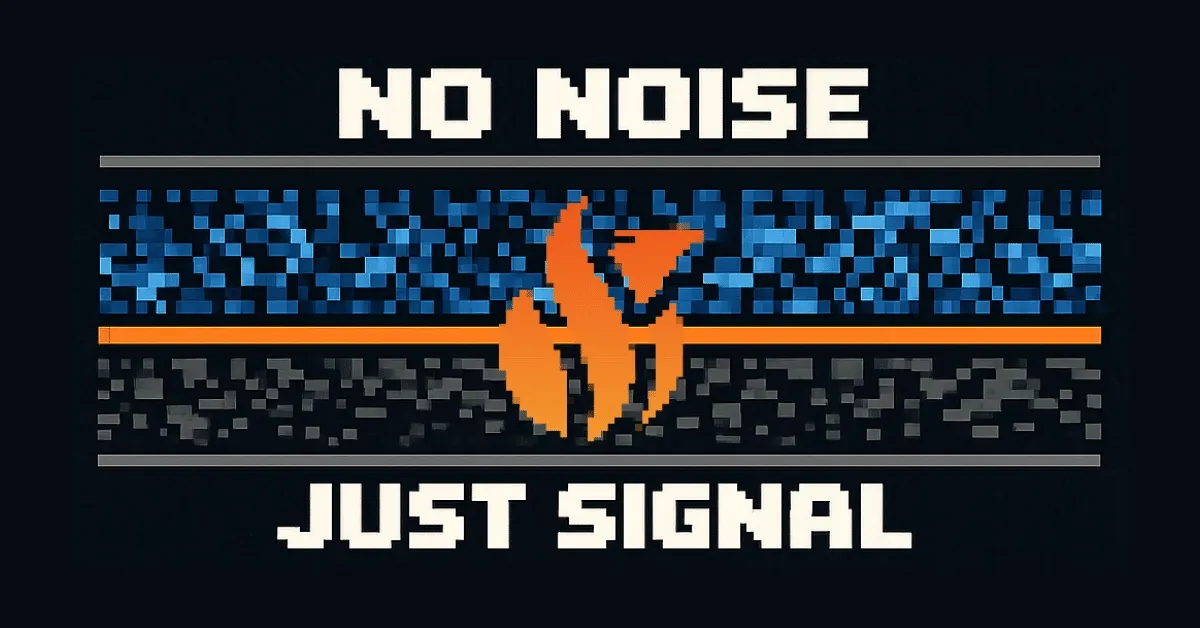
No noise. Just signal.
~Jori 🤘🔥
Become a Subscriber
EMBEROT WILL NEVER SELL, RENT, LOAN, OR DISTRIBUTE YOUR EMAIL ADDRESS TO ANY THIRD PARTY. THAT’S JUST PLAIN RUDE.